Episode 6: We Care About Mental Health… Maybe
A phrase that looks great on a poster and falls apart the moment someone takes it literally.
By: Becky Johnson, Consultant
Somewhere in every employee handbook is a sentence that reads something like: “We care deeply about the mental health and wellbeing of our team.” It’s a good sentence. Warm, modern, easy to put on a careers page next to a stock photo of people laughing at laptops. The only issue is that sentence was never actually tested against what happens when someone tries to use it.
This is the gap at the center of workplace mental health today: companies that genuinely believe they mean it, sitting across the table from employees who’ve learned, very specifically, not to believe them. Both groups are sincere. Only one of them has had to test the claim.
We Foster Open Conversations” … Maybe
This isn’t a vague vibe — it’s a measurable, well-documented gap. A study from The Hartford and NAMI found that 68% of employers believe they foster an open, inclusive environment that encourages talking about mental health, while only 42% of employees agree. The same research found that 71% of employers believe they offer employees enough flexibility to get mental health support, compared with just 44% of workers who actually feel they have it.
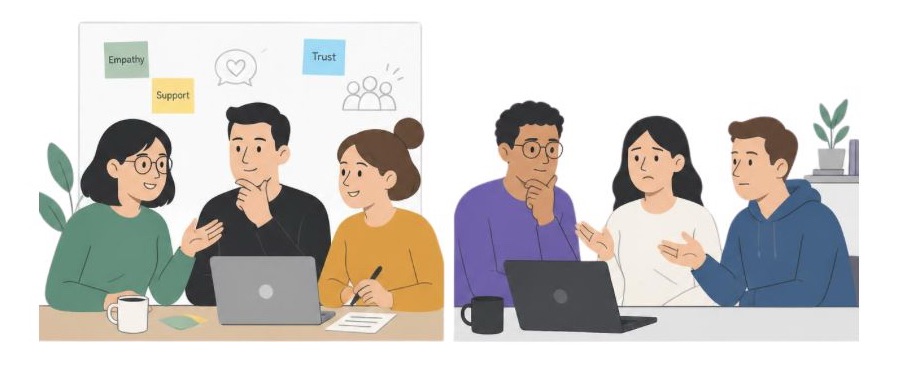
Notice what’s happening here: this isn’t employees calling employers liars. It’s two groups describing the same company and arriving at two different sentences. One of them wrote “we foster open conversations” for the all-hands slide. The other one tried to have one, and found out the slide was aspirational.
“We Built This Because We Care” … Maybe
Some of this gap isn’t an accident — it’s the intended design. Research from Modern Health and Forrester Consulting surveyed managers directly on why their companies actually rolled out mental health benefits, and 48% said they believed leadership implemented the benefits to “tick a box” rather than create real change. Not a guess from outside the building. Nearly half of the people managing other humans, from the inside, calling it what it is.
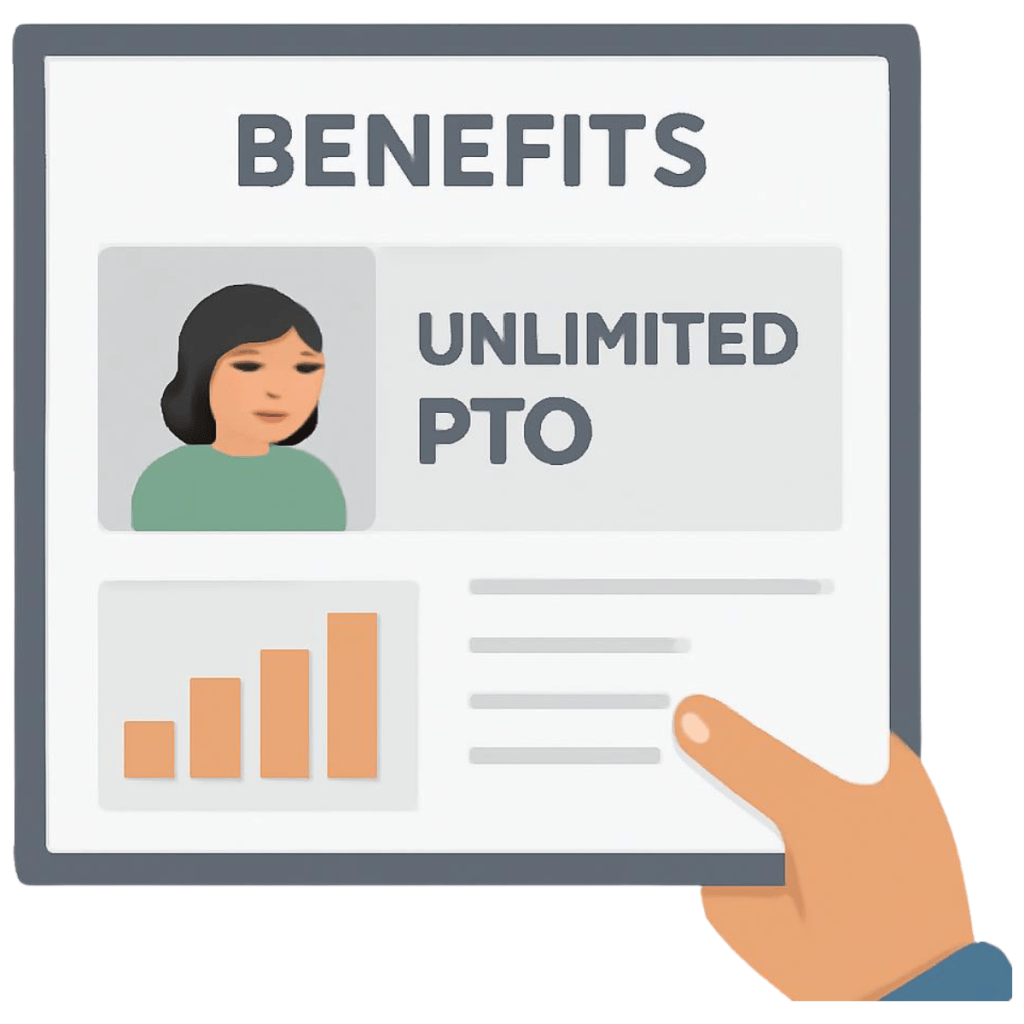
Somewhere, a benefits page is being updated to add “unlimited PTO,” directly beneath a culture where nobody has taken more than four consecutive days off since the policy launched.
And the disconnect cuts both ways in an ugly fashion: the same research found that 80% of C-suite leaders and 73% of HR leaders believe employees today expect too much mental health support from their employer. So “we built this because we care” quietly competes with a second, unspoken sentence running in leadership’s head: “and we kind of resent being asked to prove it.” That’s a hard thing to build a genuinely supportive culture on top of.
“We Welcome This Conversation” … As Long As You Don’t Start It
Even where the benefits genuinely exist, the culture around using them often doesn’t survive contact with the actual office. NAMI’s workplace mental health polling found that 74% of employees say it’s appropriate to discuss mental health at work in principle — but only about 6 in 10 say they’d actually feel comfortable doing so themselves. The reasons employees gave were remarkably consistent: fear of stigma or judgment, nobody else ever bringing it up first, and not wanting to seem weak in front of people who decide their raises.
That gap between “it’s fine to talk about” and “I would never personally bring it up” is the whole slogan in miniature — the welcome mat says everyone’s invited. Nobody in the room is actually standing on it.
“We Know This Is Hard” … But Did You See the Friday Deck?
Meanwhile, the need behind all of this isn’t manufactured or exaggerated. Survey data shows 62% of employees say they’ve been pressured to work through burnout or a mental health struggle rather than take the support that was technically offered, and only 36% believe their workplace benefits provide genuinely adequate mental health support. A striking 81% of employees say their workplace needs stronger mental health benefits than what currently exists on paper.
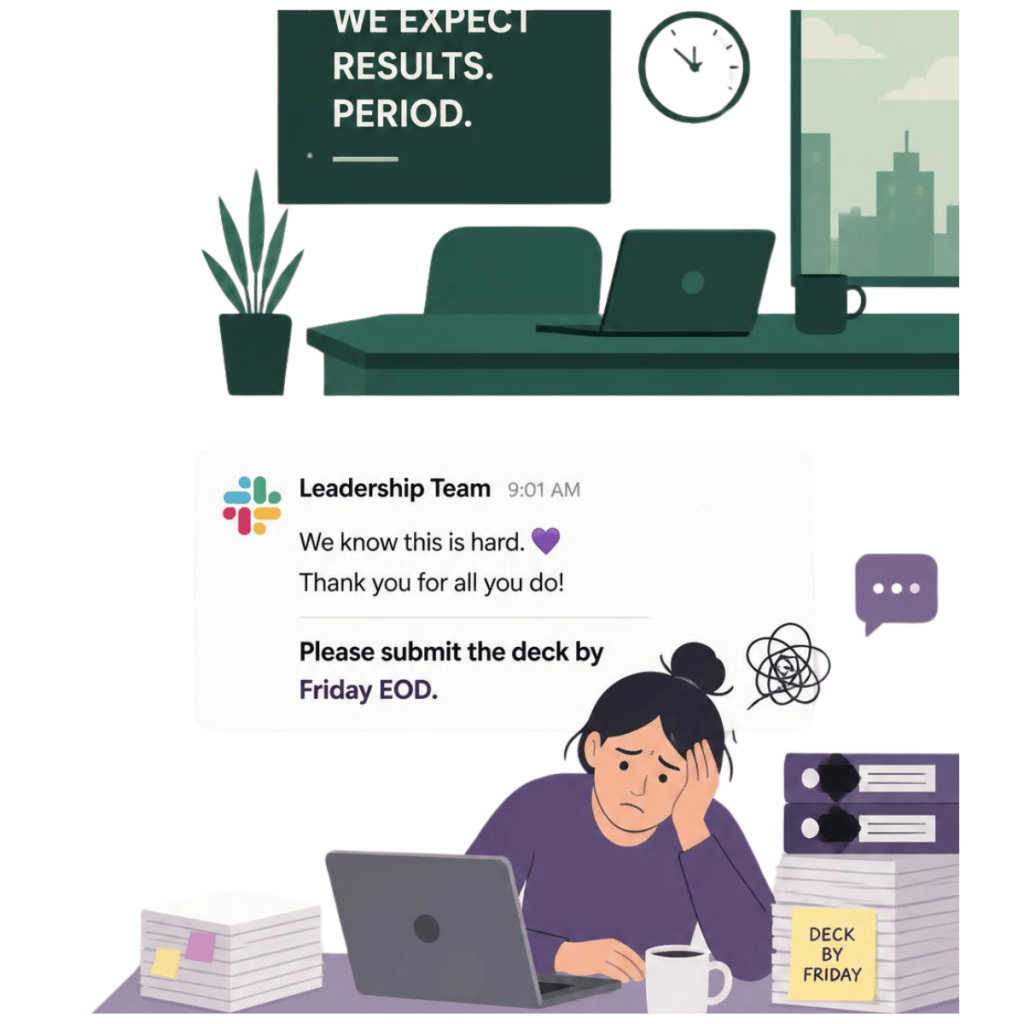
This is what makes the performed version worse than simply having nothing: a company with zero wellness language at all is at least being honest about where it stands. A company that puts “we know this is hard” in the Slack announcement, and then still expects the deck by Friday regardless, is asking employees to feel cared for and unsupported in the very same sentence.
“We Didn’t Say Anything At All” … And That Cost More
And here’s the honest caveat to that last point: a hollow slogan is bad. No slogan at all — no plan, no benefit, no language in the handbook, nothing — is its own, separate problem, and the data on it is just as unflattering. Globally, mental health conditions like depression and anxiety are estimated to cost the world economy roughly $1 trillion every year in lost productivity. In the U.S. alone, missed work tied to mental health challenges costs businesses an estimated $47.6 billion annually, with absenteeism linked to depression specifically accounting for close to $44 billion of that on its own.
Where this has been measured in more granular detail, the shape of the cost is consistent: Deloitte’s UK analysis put the annual cost of poor workplace mental health at £56 billion, broken down into presenteeism (£28 billion), staff turnover (£22 billion), and absenteeism (£6 billion) — a total that had climbed 25% since 2019. Presenteeism — showing up and quietly underperforming — is consistently the single largest line item, which tracks: it’s the cost nobody schedules a meeting about, because on paper, everyone’s still logged in.
No poster, no slogan, no plan — just a very productive-looking spreadsheet, and a lot of people quietly running on empty underneath it.
The human side of that number is worse than the dollar figure. In the same UK research, 89% of employees experiencing a mental health issue say it affects their working life, and more than half of that group say they’ve seriously considered resigning because of it. Separately, 77% of employees who went through a mental health crisis say they kept working through it anyway, and 68% say they’ve felt guilty for prioritizing their own mental health over their job. Without any formal plan in place — not even a performative one — there’s no permission structure at all. Nobody says “we care” out loud, so nobody feels entitled to act like it’s true.
The upside, for any employer actually looking for one, is that this is a rare case where doing the right thing and doing the profitable thing point the same direction: Deloitte’s modeling found that genuine workplace mental health initiatives can return as much as 800% on their cost, through higher productivity, fewer sick days, and lower turnover. Saying nothing isn’t a neutral, cost-free option. It’s just a cost that doesn’t show up on the same slide.
What “We Care” Would Actually Require
None of this requires a bigger benefits budget so much as it requires the sentence already on the careers page to survive contact with reality. It requires:
- Leaders who go first — a mental health benefit only becomes real once someone senior visibly uses it without apologizing for it.
- Managers trained, not just informed — an email announcing a benefit isn’t the same as a manager who knows how to respond well when someone actually uses it.
- Usage without penalty, verified, not assumed — if taking a mental health day quietly affects someone’s next review, the sentence was never true to begin with.
- Measuring outcomes, not enrollment — signing up for the meditation app isn’t the metric that matters; whether people feel safer and less burned out six months later is.
- Asking employees, not guessing on their behalf — the gap between what leadership thinks is supportive and what employees experience only closes when someone actually asks the second group.
“We care about mental health” is a sentence that costs nothing to write and everything to actually mean. Employees can tell the difference almost immediately — usually around the first time they test it. After that, the slogan doesn’t just fail to help. It actively costs the trust it was supposed to build. And for the companies skipping the sentence altogether: the silence was never free either. It was just billed somewhere nobody was looking.
Data sourced from The Hartford and NAMI’s Mental Health Divide study, the NAMI-Ipsos Workplace Mental Health Poll, Modern Health’s research conducted by Forrester Consulting, Deloitte’s UK workplace mental health cost analysis, and additional workplace mental health survey data (2024–2026).

Up Next: Pretending Pay Fixes Culture


Leave a Reply