Series II: Toxic Workplace Woes
Episode 4: Ghosted at Work: The Recognition That Never Checks In.
You didn’t quit. You slowly stopped existing to the people who were supposed to notice.
By: Becky Johnson, Consultant
You know the modern dating move: someone goes quiet mid-conversation, no explanation, no closure, just silence where a response should be. Most workplaces run the exact same play on their best employees — except instead of a bad text exchange, it’s a whole career. You do the work, you solve the problem, you catch the thing before it became a disaster, and in return: nothing. No acknowledgment. No “noticed that.” Just the company equivalent of being left unread.
This is the recognition void, and it turns out ghosting your own employees is one of the most expensive habits a company can develop.
The Employees Nobody Sees

Let’s start with how widespread the haunting actually is. Gallup research finds that roughly 65% of employees say they received no recognition at all in the past year. Not “not enough.” None. A full trip around the sun spent doing visible, valuable work while functionally invisible to the people signing off on it.
Zoom in further and it gets eerier: in Gallup’s ongoing engagement research, only about 1 in 3 U.S. employees strongly agree they’ve received recognition or praise for good work in the last seven days. Which means for two-thirds of the workforce, the last time someone actually looked up and said “nice work” is genuinely hard to pin down — filed somewhere between “that one good performance review” and “a past life.”
iHire’s 2026 Toxic Workplace Trends Report backs this up from a different angle: 65.0% of employees who described their workplace as toxic cited a lack of support — including recognition and appreciation — as one of the reasons why. And in last year’s version of the same survey, 72.2% of employees who called their workplace unsupportive pointed specifically to a lack of recognition or appreciation as the reason. Being unseen isn’t a minor inconvenience sitting next to the free snacks. It’s structural.
The Group Chat Where Nobody’s Actually Named
Here’s the trap a lot of companies fall into: they do try to show up. Just badly. A cheerful, all-caps “GREAT JOB TEAM!!” dropped into a company-wide Slack channel, addressed to some unspecified subset of the 400 people in it, none of whom are named, none of whom did remotely the same amount of work.
Congratulations to whoever did the thing. You know who you are. The other 399 of you, please continue as normal.
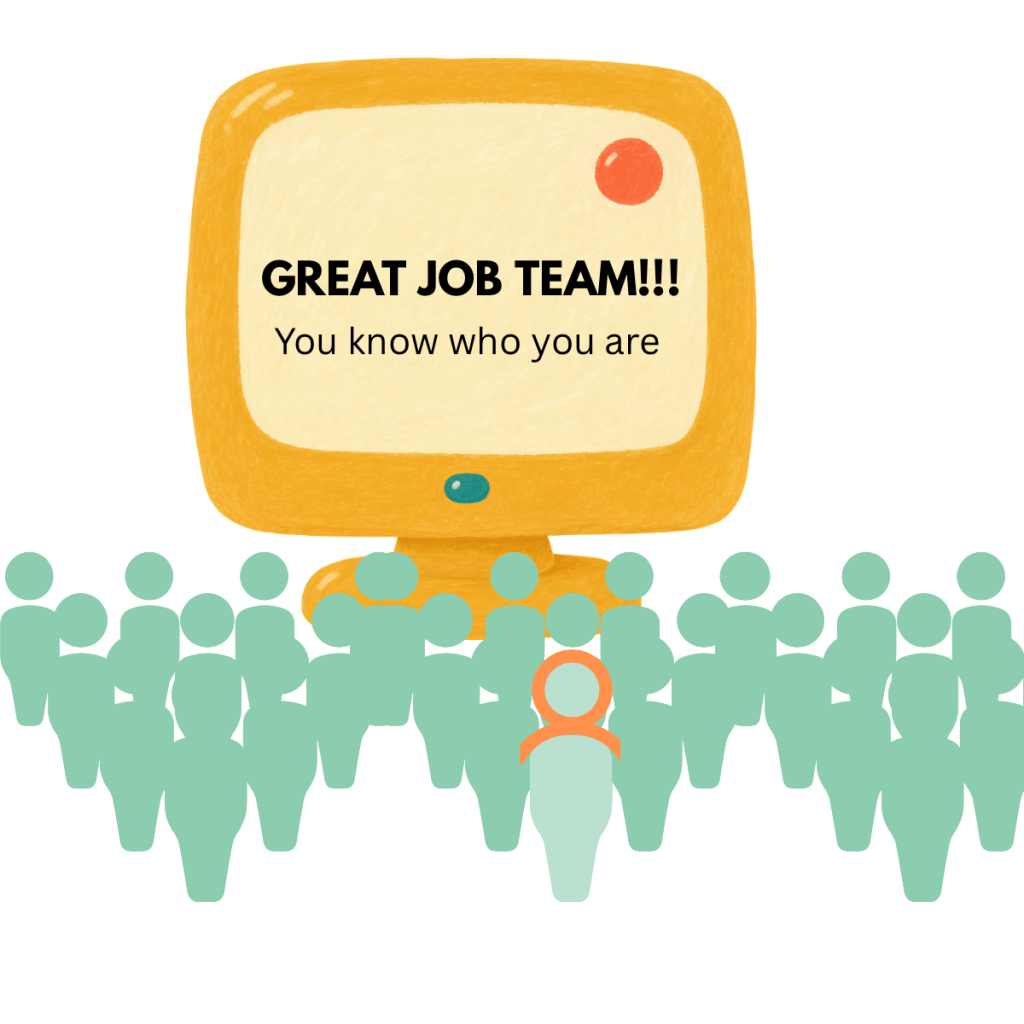
This is recognition addressed to no one in particular — broadcast, not directed; a wave into a crowd instead of eye contact with a person. And employees can tell the difference immediately, which is exactly why vague, group-wide praise doesn’t land the way real recognition does. iHire’s 2026 survey found that 63.3% of employees consider recognition and appreciation essential to a positive workplace — not “present in some diluted, unaddressed form,” essential.
When asked directly what would most improve a toxic environment, employees ranked recognition right alongside management training and just behind work-life balance — 63.3% named employee recognition/appreciation as one of the most impactful fixes, trailing only clear communication from leadership (79.0%) and strong work-life balance (65.1%). Employees aren’t asking for a parade. They’re asking to be looked at directly and told, specifically and occasionally, that someone noticed they were even in the room.
The Invisible Workload
There’s a specific, well-documented flavor of this problem worth calling out by name: performance punishment — what happens when doing great work doesn’t make you more visible, it makes you more useful to haunt. Hit your numbers, and you’re handed more numbers to hit. Solve the crisis, and you quietly become the person crises get routed to by default, without anyone ever officially saying so out loud. HR researchers also call this the “quiet promotion”: all the added responsibility of a step up, none of the title, pay, or announcement that would normally make it visible.
The logic, from a manager’s chair, is almost sympathetic — give the hard thing to the person who won’t drop it. But from the employee’s chair, it reads very differently: do this well, and you will simply keep doing it, unseen, forever. A peer-reviewed study of 534 employees across IT organizations found that this kind of performance punishment doesn’t just erode morale in the abstract — it measurably increases knowledge hoarding and knowledge hiding, meaning your most capable people start quietly disappearing on purpose, holding back the exact expertise that made them indispensable in the first place.
This is very likely part of why recognition has become such a visible burnout driver: DHR Global’s 2026 Workforce Trends Report found that “lack of reward or recognition” nearly doubled as a cited burnout driver, climbing from 17% in 2025 to 32% in 2026. That’s not a slow drift — that’s an entire year of top performers noticing they’re doing more and being seen less.
The tell is almost always the same sentence, delivered with a straight face: “Oh, just give it to [name] — they’re great at this.” Congratulations, [name]. You have been promoted to Default Answer, a role with unlimited responsibility, zero visibility, and a start date of immediately.

The fix isn’t “stop giving good work to good people” — that’s not realistic, and frankly it’s not what most high performers actually want. The fix is making sure extra work doesn’t come with extra invisibility: name it out loud, factor it into workload and title conversations, and back it with something more substantial than a passing emoji. Otherwise the message top performers receive, loud and clear, is that competence is the fastest route to disappearing — so the smart move becomes fading quietly, or leaving for somewhere that actually looks up.
The Disappearing Act
Eventually, people who’ve been ghosted long enough stop waiting for a reply and just leave. Research from O.C. Tanner found that 79% of employees who quit their jobs cited a lack of appreciation as a primary reason for leaving. Not pay. Not the commute. The simple, accumulated experience of not being seen.
This tracks with what SHRM has found as well: employees who don’t feel valued are significantly more likely to report high stress. Stressed, unseen employees don’t tend to stick around hoping someone eventually notices. They update their resume instead, usually on a lunch break, usually right after another meeting where their work got credited to someone else’s slide.
The quietly savage part: none of this is a mystery to the company after the fact. Exit interviews routinely surface “lack of recognition” as a top reason for leaving — which means most organizations aren’t surprised by the disappearance so much as mildly inconvenienced by the timing.

What Being Seen Actually Prevents
Here’s the part that should make leadership sit up: being seen is one of the cheapest retention tools available, and the data backs it up. Companies with strong recognition cultures see 31% lower voluntary turnover than those without one, according to Bersin by Deloitte. Separately, employees who receive regular recognition are 56% less likely to be actively job-searching, per Workhuman/Gallup research.
Given that replacing an employee typically costs 50–200% of their annual salary, the fix here isn’t complicated or expensive — it’s just a matter of someone actually looking up. Genuine, specific acknowledgment is one of the best-performing retention tools available, and one of the only ones that costs nothing to try.
How to Stop Ghosting Your Own Employees
None of this requires a recognition platform with gamified points and a leaderboard. It requires:
- Specificity over volume — “Great job on the Morrison deck, the client called out your revenue slide specifically” beats a generic shout-out to a whole department every time.
- Timeliness — recognition six months after the fact, buried in an annual review, doesn’t land the same way as recognition given while the work is still fresh.
- Distribution, not concentration — if the same two people get seen every time, it stops reading as recognition and starts reading as favoritism with better PR. (Hmmm…favoritism? Why does that sound familiar? – read Episode 3 😜)
- Peer-to-peer channels, not just top-down — recognition doesn’t have to come from a manager to count; it just has to be genuine.
- Actually saying it out loud — the single most common failure mode isn’t a bad recognition program. It’s silence.
- Naming extra work as extra work — if a top performer’s reward for excellence is a heavier load, that load needs a real conversation about title, pay, or scope — not just the assumption they’ll keep absorbing it because they always have.
Recognition doesn’t fix a toxic workplace on its own — it won’t undo bad leadership or a broken promotion process. But it’s one of the rare fixes that’s genuinely low-cost, high-impact, and entirely within any manager’s control by next Tuesday. There is no reasonable excuse for good employees to still be disappearing in plain sight.
Data sourced from iHire’s 2025 and 2026 Toxic Workplace Trends Reports, Gallup, O.C. Tanner, SHRM, Bersin by Deloitte/Workhuman, DHR Global’s 2026 Workforce Trends Report, and peer-reviewed research on high-performance punishment (2024–2026).

Next up in the series: the manager who confuses watching you with leading you — a deep dive into micromanagement, and why “trust” and “constant surveillance” are not, in fact, the same management style.


Leave a comment